- What broke
- ORACLE, a desk of LLM analysts with a judge model, had been tuned for weeks: exits, stop widths, conviction thresholds, symbol allowlists. Its book kept bleeding.
- How it was found
- A replay harness re-ran every recorded decision. Before any cost, the stream lost money: 33% wins over 97 trades in 25 sessions. A sweep of 29 exit structures and 7 subset families found nothing that could be chosen in advance.
- The fix
- Benchmarked each pick against a random long or short in the same universe at the same instant. Selection alpha was negative in all 14 horizon and side cells. The desk was retired rather than tuned further.
- The rule it left
- Measure selection against a random baseline before touching execution. Tuning exits cannot rescue a pick that loses before costs.
Five trading ideas failed their own tests. One passed. This is the platform that told them apart.
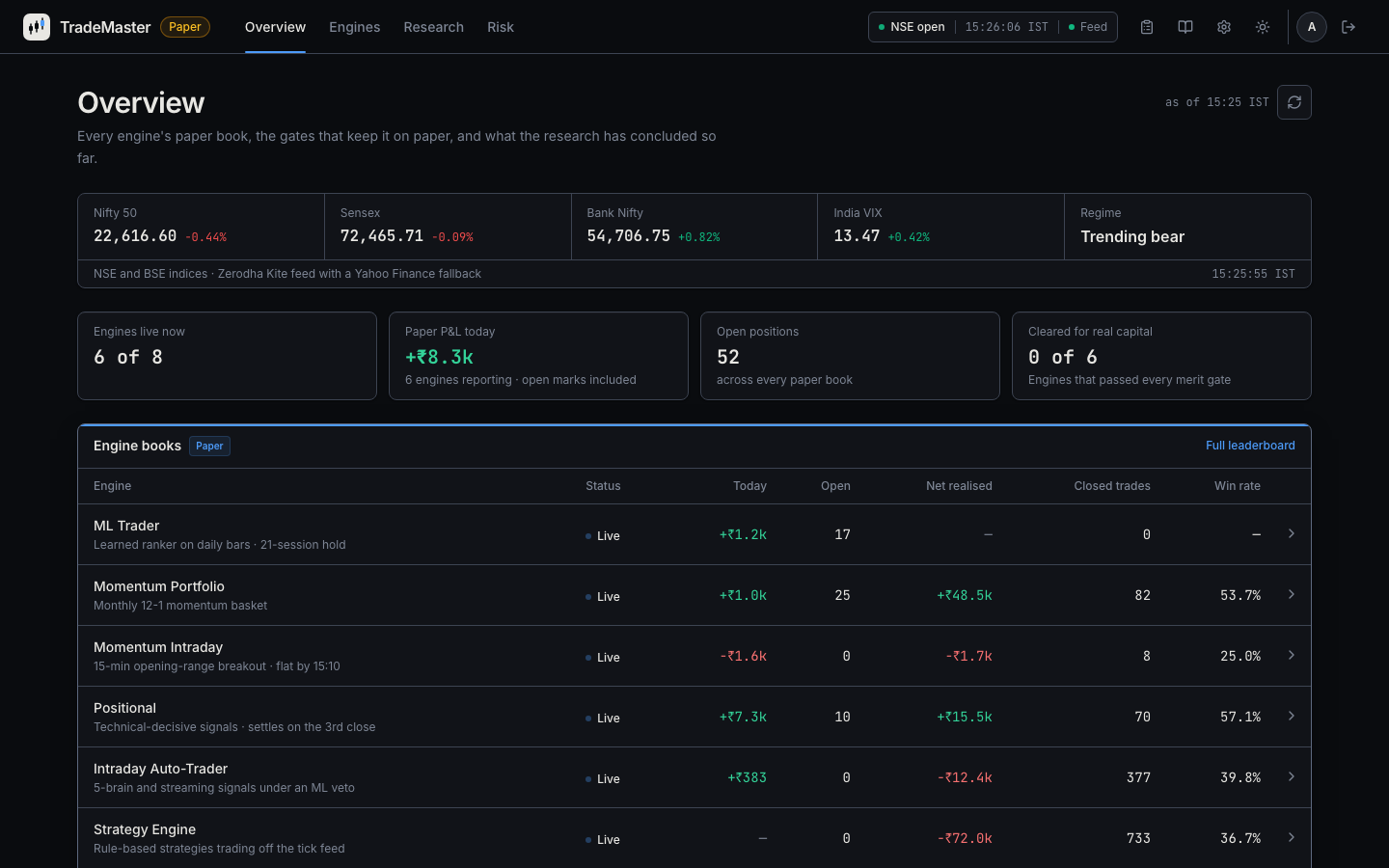
TradeMaster is a research and paper-trading lab for Indian equities, built by one person. It runs six engines against live NSE prices, charges every trade real Indian costs, and keeps a dated ledger of what the evidence says, including when the answer is no.
Paper-traded only. No real capital, and nothing here is investment advice.
FindingExperimentVerdictEvidence
F-040 · F-04621-session learned ranker (ML Trader)Edge+1.25% per entry over its universe after costs; 95% lower bound +0.68% across 132 independent blocks of a 15-year panel
F-0365-session learned rankerNo edgeTop decile lost money after costs; margin indistinguishable from a label-shuffled null
F-023 · F-024ORACLE, an LLM intraday trading deskRetiredLost money before costs over 97 trades; alpha against a random pick negative in all 14 horizon and side cells
F-00112-1 monthly momentumNo edgeDid not persist in a five-year out-of-sample test; kept running on paper as a benchmark
F-004Rule-based intraday day-traderParkedNo edge once Indian statutory costs and measured slippage were charged
F-005Small-capital intraday tierParkedNo edge even before costs
From the platform’s findings ledger, September 2026. “Edge” is a backtest verdict on a 15-year panel; the live paper record needs years of sessions before it can confirm or refute it.
- paper engines running on live NSE prices
- 6
- dated findings in the research ledger
- 47
- defects filed in the bug ledger, each with a severity
- 193
- automated backend tests
- 2,400+
What the platform does
Market data flows into a set of models; each paper engine turns model output into orders on a simulated book priced off the live feed; and a research harness grades every engine against the same cost model and the same statistical bar. Verdicts flow back: an engine that fails is halted, parked or retired.
- Data
- Zerodha Kite ticks and history
- Yahoo Finance fallback
- Fundamentals, flows and news
- Models
- Five scoring brains
- Ridge ranker on daily bars
- Regime detector
- Rule-based strategies
- Engines
- Six paper engines
- ML veto, drift halt, loss breakers
- Books
- Simulated fills on live prices
- Indian statutory costs
- Measured slippage
- Judgement
- Replay and research harness
- Findings ledger
- Merit gates
Verdicts return to the engines: halt, park or retire.
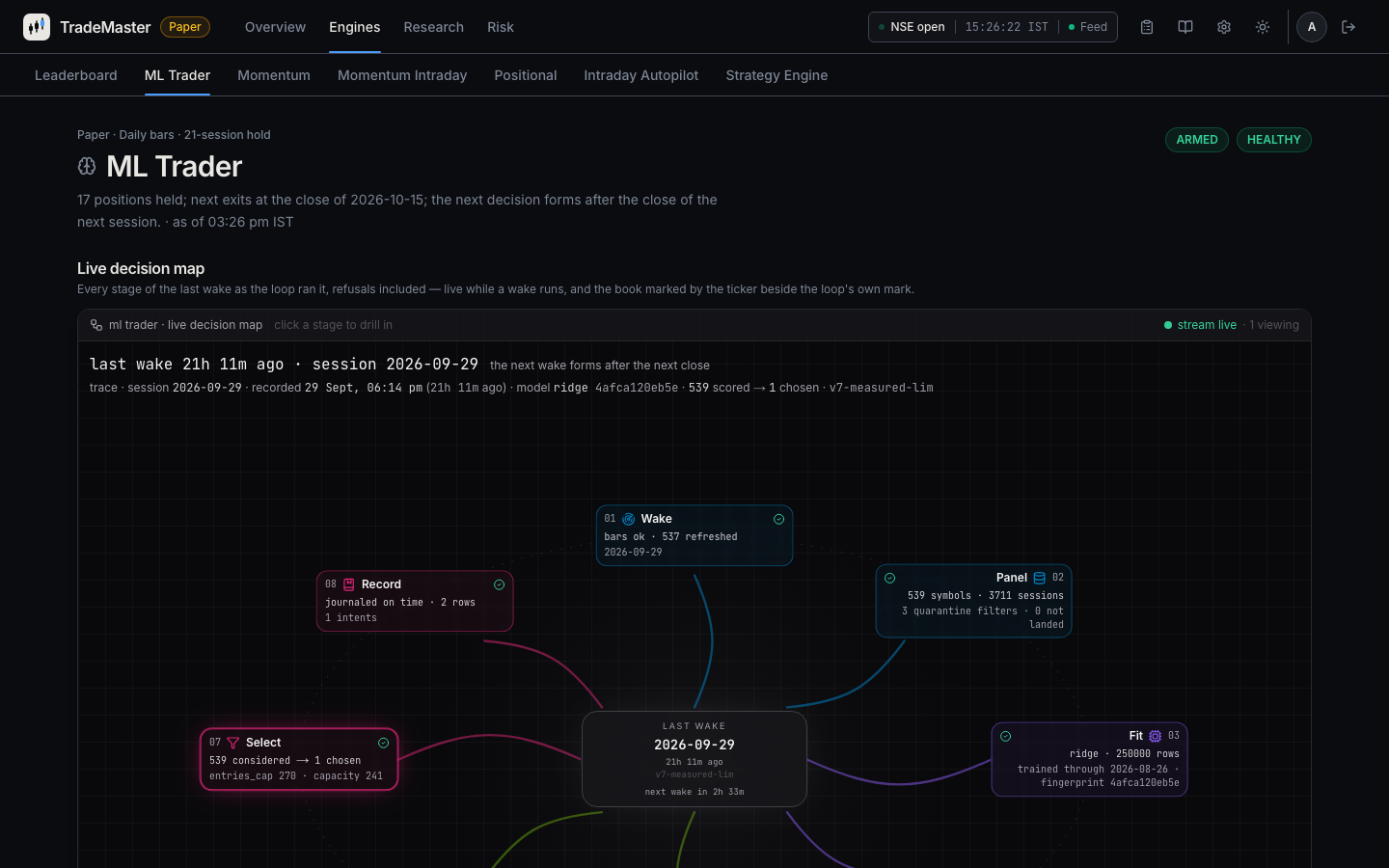
ML Trader
Ridge ranker fitted point-in-time each session over 539 names, with capacity, sector and correlation caps
Decides after 18:00 IST · 21-session hold
Momentum Portfolio
Monthly 12-1 momentum basket of 25 names, rebalanced at month end
Monthly
Momentum Intraday
15-minute opening-range breakout on the top momentum names, one bracket per name
Flat by 15:10 IST
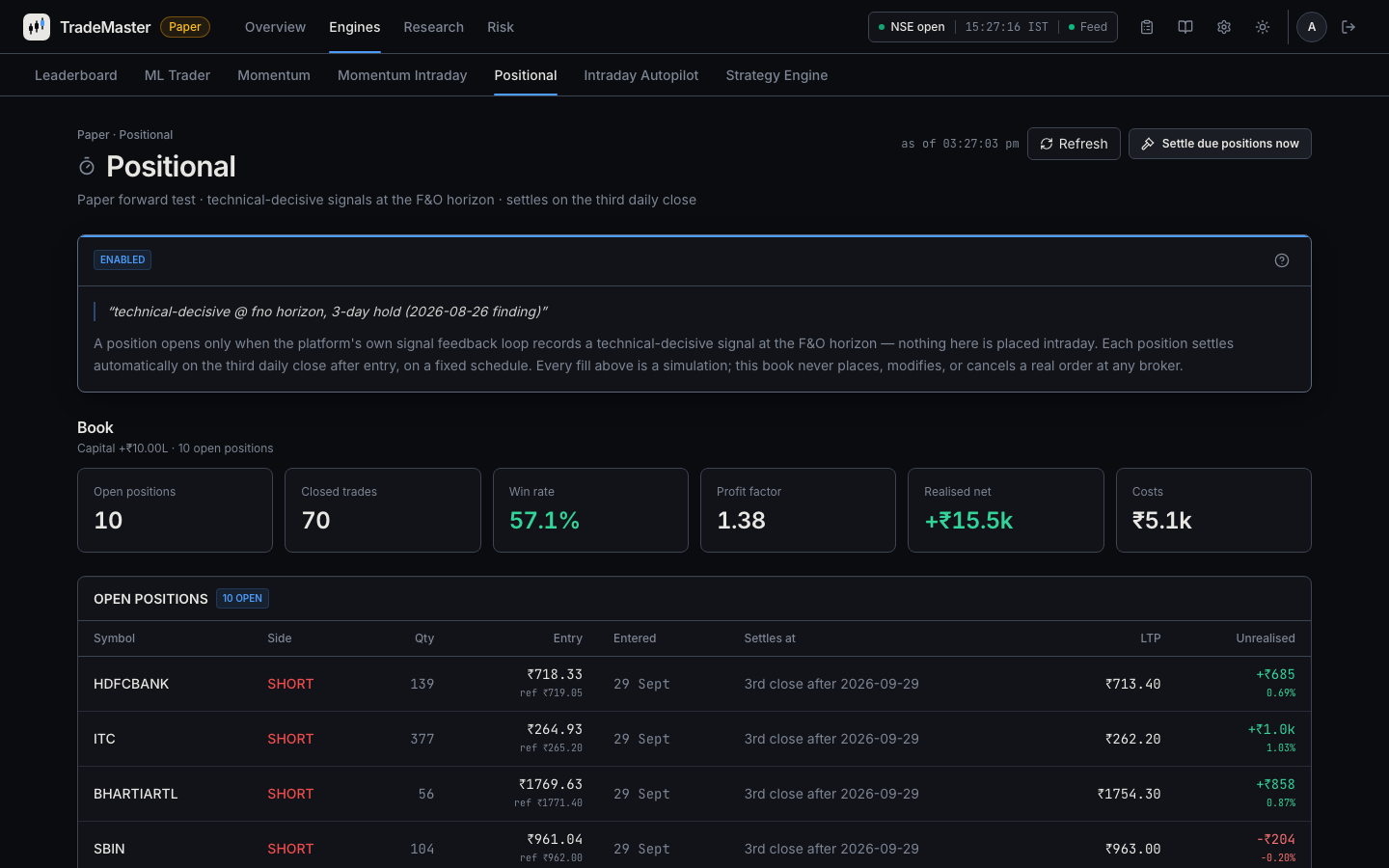
Positional
Takes the technical brain's decisive calls at the F&O horizon
Settles on the third close
Intraday Auto-Trader
Trades the five-brain signal stream under an ML veto, a drift halt and a loss breaker
Starts 09:20 IST
Strategy Engine
Two dozen rule-based strategies, each with its own paper book, driven by the tick feed
Intraday
Live paper results
The five-brain autopilot’s paper book over the last 90 days, read live from the platform. It is currently losing money, and this page shows that rather than hiding it.
- Win rate
- —
- Average win ÷ average loss
- —
- Deepest drawdown
- —
- Net P&L
- —
loading
per closed trade
from the window’s peak
last 90 days
The equity curve appears once the autopilot has two sessions in the window.
P&L as each paper position books it, net of Indian statutory costs. Paper trading only; not investment advice.
How a verdict is reached
Most of the work went into the measurement, not the models. Four rules decide what the ledger is allowed to say.
The falsifier is written before the data exists
Each study registers its question, its test and what would count as failure before the probe runs, and applies that rule verbatim afterwards. A result can only be overturned by naming the input that changed.
Beat a null, not zero
A strategy has to beat its own universe, a label-shuffled copy of itself and a random pick made at the same instant. The LLM desk looked profitable on longs until it was compared with a random long; the whole gain was the tape.
Sample size is days, not trades
Trades opened on the same day share one market. Verdicts use moving-block bootstrap lower bounds and refuse to rule below a floor of independent blocks.
Costs are charged twice, as they are in life
Slippage moves the fill price; STT, stamp duty, exchange, SEBI and GST charges come off after. Every book and every label is graded net of both, and capacity is tested at real position sizes.
Build log: four things that broke
Each one looked like a strategy problem and turned out to be a measurement or engineering problem. Each left behind a rule the platform now enforces.
Decisions and tradeoffs
Ridge regression over deep learning
The surviving model is a ridge ranker refitted every session. When it is wrong, the fault is traceable to a feature, a fold or a cap. A deeper model would have hidden that behind variance nobody could audit.
Paper books on live prices, not backtests alone
Every engine trades a simulated book against the live Zerodha Kite feed with Indian costs charged on every fill. For ML Trader, each live fill is checked against the label the research harness computes for the same name and session (F-043).
Gates that halt without asking
A drift detector, an ML breaker, loss circuit breakers and a kill switch can stop any engine. A halted engine is treated as the system working; nobody routes around a gate to make it trade.
Small stack, shared box
FastAPI, Postgres, Redis and Next.js on one shared VPS under PM2. Deploys are phased scripts with a canary bracket, because the market sees a bad deploy before its author does.
Where it goes next
Now
- ML Trader accruing a live paper record, one entry a session into 21 slots
- One overview of every engine's paper book, net of costs
- Disaster recovery drilled: nightly verified dumps and a proven restore
Next
- An off-site copy of the corpus
- Capacity-aware sizing from the measured liquidity ceiling
- SEBI algo-registration readiness before any real capital
Cut
- ORACLE, the LLM intraday desk
- The rule-based day-trader and the small-capital tier
- LLM arena, AlphaForge and the options autopilot
About the builder
I’m Anustup, a branding, communications, and marketing professional transitioning into AI Product Management. I spent 10+ years building brands, shaping communication strategy, and running marketing for enterprise clients at a Bengaluru agency. TradeMaster AI is my attempt to learn ML product development the way I think PMs should — by building, breaking, and documenting something end-to-end rather than reading about it.
I’m exploring AI PM, Growth PM, and Growth Intelligence roles at Indian tech and fintech companies. If you’re hiring, or want to talk about the build: mukherjeeanustup@gmail.com · LinkedIn.